Founding Fossils
When Science, Art, and Accessibility Collide
In 1801, Charles Willson Peale and his son Rembrandt launched what would become the first scientific expedition in U.S. history—unearthing massive bones from a New York farm that were later identified as a prehistoric mastodon. That discovery helped introduce a radical idea to the American public: species could go extinct.
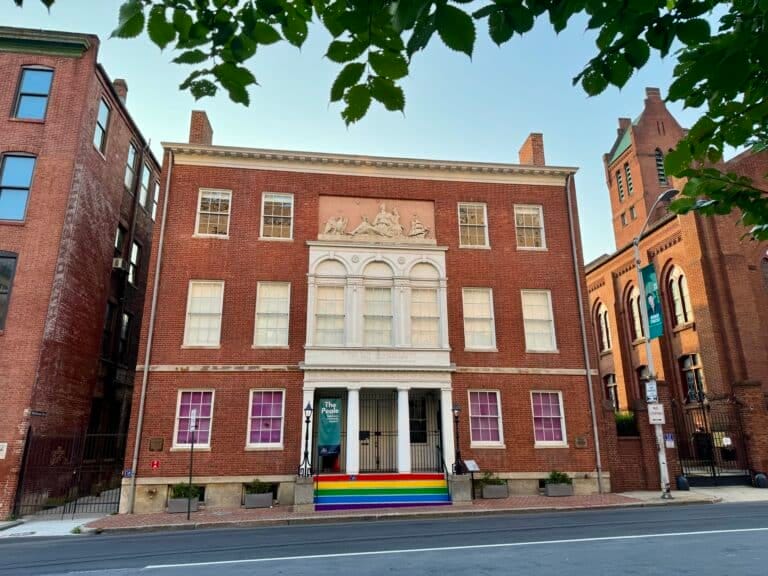
At The Peale—Baltimore’s Community Museum—Founding Fossils revisits that pivotal moment in American science and public education, connecting early natural history to the ways we learn, interpret, and share knowledge today. The story links art, archaeology, and museum innovation, inviting visitors to consider how scientific ideas move from excavation to exhibition—and into public understanding.
More than two centuries later, Founding Fossils presents this foundational story through a contemporary, accessible lens. Conceived by archaeologist and accessibility consultant Dr. Cheryl Fogle-Hatch, the exhibition brings together history, art, and cutting-edge technology to create a multisensory, touch-accessible museum experience for sighted and blind visitors alike. Designed with inclusive interpretation at its core, the exhibition demonstrates how accessibility strengthens engagement for everyone.
The exhibition features 3D-printed replicas of mastodon fossils originally collected by the Peales and early American leaders. These objects—scanned by Dr. Bernard Means and the Virtual Curator Laboratory at Virginia Commonwealth University—are paired with sculptural and graphic elements inspired by Founding Monsters, an award-winning comic series exploring how science, politics, and archaeology intersected at the dawn of the United States. Together, these elements provide multiple entry points: tactile exploration, visual storytelling, and historical context.
On view through 2026 at The Peale.
Free admission. Donations welcome.
For full exhibition details, collaborators, and visiting information, explore the complete exhibition page.

By blending tactile objects, graphic narrative, and historical interpretation, Founding Fossils invites visitors to experience early American science in new ways—and to reflect on how knowledge is created, shared, preserved, and made accessible in museums and communities. The exhibition serves as a model for inclusive exhibit design, demonstrating how public history can be both innovative and equitable.